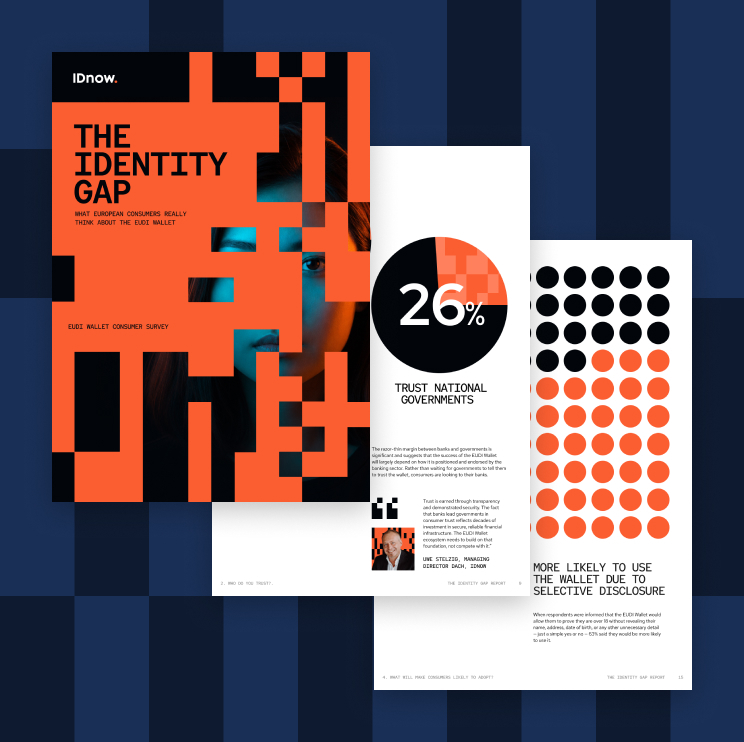
2,000 consumers across France and Germany told us what they really think about the EUDI Wallet. What they know. What they fear. What it will take to win their trust.
The EUDI Wallet Consumer Survey reveals an identity gap between what consumers want and what institutions are delivering. Download the report to discover more. Financial institutions have until December 2027 to close the identity gap.
European consumers understand the problem the EUDI Wallet is designed to solve, but they have not yet been convinced that this is the solution. They know identity fraud is rising, that online verification is broken, and that sharing more data than necessary carries real risk. What they haven't yet seen is a solution they can trust, and that is precisely the gap the EUDI Wallet must close.
Philippe Morel
CEO, IDnow
Key Findings
5 Things the Data Tells Us About Trust and Adoption
Consumers support the principle of digital identity. What's holding them back is awareness, trust in who manages it, and friction in how it's delivered.
01
51
%
Awareness Lags the Rollout
Over half of Europeans have never heard of the EUDI Wallet, despite the obligation for member states to make it available by December 2026, and for banks to accept it by December 2027.
02
87
%
Security Fears Run Deep
87% are concerned about hacking or data theft, and 86% about account fraud. Trust has to be earned before adoption follows — fear, not apathy, is the default reaction.
03
63
%
Selective Disclosure Is the Adoption Lever
63% say they'd be more likely to use the EUDI Wallet once they understood it lets them share only what a transaction needs, such as proving they're over 18 without revealing their name, address, or date of birth.
04
46
%
Friction Is Already Costing Revenue
Almost half of consumers have abandoned a transaction because identity verification was too difficult or time-consuming — a structural, measurable revenue leak for anyone onboarding customers today.
05
27
%
Banks, Not Governments, Hold the Trust
Financial institutions (27%) narrowly edge out national governments (26%) as the institution consumers trust most to manage their digital identity. The margin is thin, and the opportunity is real.
Trust is earned through transparency and demonstrated security. The fact that banks lead governments in consumer trust reflects decades of investment in secure, reliable financial infrastructure. The EUDI Wallet ecosystem needs to build on that foundation, not compete with it.
Uwe Stelzig — Managing Director DACH, IDnow
Methodology
Who We Surveyed
A nationally representative sample, weighted by age and gender in each market, covering awareness, trust, risk perception, and onboarding preferences.
By Market
France
1,000
Germany
1,000
Total respondents
2,000
Study Details
Fielded by
Sapio Research
Survey period
June 2026
Questions asked
22
Respondents were aged 18–80 and weighted to reflect the national population by age and gender in each market. Margin of error is ±2.2 percentage points at the 95% confidence level. Where France–Germany differences are noted in the full report, they are statistically significant at the 95% confidence level unless otherwise stated.
Get the Full Report
The Identity Gap.
What 2,000 European consumers really think about the EUDI Wallet, and what it means for banks, telcos, governments, and every organisation building their identity verification stack.
Full breakdown of awareness, trust, and adoption data across France and Germany
What consumers fear most about digital identity wallets, and how to address it
Why selective disclosure is the clearest lever for adoption IDnow has measured
What friction is costing onboarding teams, by generation and by market
IDnow's view on what banks, telcos, and governments should do next
Download the Report
Free download. See what 2,000 European consumers told us, and what it means for your organisation.